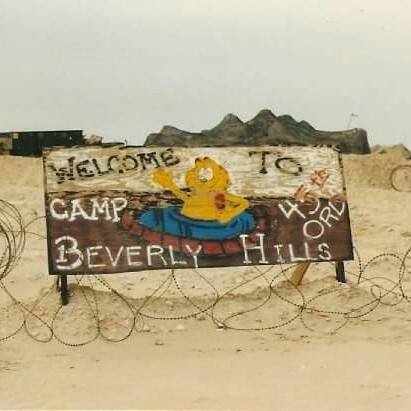
REAR ECHELON BATTLES
by CPT Andrew G. Entwistle, USA
Cdr, 45th Ord Co, XVIII Abn Corps
Published in “Personal Perspectives on the Gulf War” by the Association of the United States Army, August 1993. https://www.ausa.org/sites/default/files/SR-1993-Personal-Perspectives-on-the-Gulf-War.pdf
This is the story of 45th Ordnance Company, deployed in Saudi Arabia from December 1990 to May 1991. Though they never fired nor heard fired a single round, its soldiers waged a very real war against fear, loneliness and uncertainty. This is the story of how they achieved victory.
I assumed command on the afternoon of 6 January 1991 , a cold and windy day, dark and threatening. When we finally decided that the support group commander was not going to show up, the first sergeant (1SG Mayne) was given his signal. Five minutes later I stood in front of 220 soldiers as their company commander, both their leader and protector. I at last had what I had always wanted, in fact, what I had begged for prior to the deployment. I had expected to be excited. I had never imagined that I would be so very afraid.
As frightened as I was, the soldiers were more so, not having access as I did to the intelligence and information on the likelihood of attack. I made it a point to walk my entire mile-long perimeter nightly, speaking to each soldier on duty and staying as long as it took to allay their fears. It was usually after midnight when I returned to my tent. Nothing is as frightening as the unknown. Every night I found violations of the general order to keep all weapons unloaded. As hard as I tried to instill confidence, my words were never as encouraging as the rasp of a magazine locking home. After the SCUDs, my greatest fear was for an accidental shooting. Each morning at the stand-to my NCOs carefully inspected each soldier for loaded weapons, and due to their care, there were no accidents.
I spent the first two weeks meeting each soldier and really trying to learn about them, wondering which ones we could count on when the balloon went up. All of us were scared, but some were deathly afraid. Sure, they had known this could happen; they weren’t stupid, but they had never planned on it. It had seemed so simple; two years of honest work and then off to college and bigger things. Now all of that ranked behind just getting home in one piece. The fear was in their eyes and in their movements. I could hear it when they spoke. “You gotta understand, Sir, SGT Uthe and I go way back, to AIT, and if anything happens to him … well, I don’t know. I don’t think I could take it.” So many had the same story: a new wife, or a new baby. I don’t remember now what I told each of them, surely a textbook pep talk that neither of us took too seriously. Those early, unsure days were the darkest for us and, try as I might, we all knew that I didn’t have the answers.
We turned in on the night of 16 January wondering why the deadline had been allowed to pass. Perhaps naively, we had sat through the midnight hour waiting for the guns at one second past. One of my lieutenants had come out from port after dark and joined me in my tent. He brought the less than surprising news that things were tense in the port and, like us, they expected the SCUDs momentarily.
When it finally came, the message that awakened me was all that I’d expected. “It’s started. Have your guys take their pills, get into MOPP and be ready to go to the bunkers.” Turning on the portable radio we listened with the rest of the world as Bernard Shaw of CNN witnessed what we could not. I paused in dressing, thinking aloud to LT McPeak: “This is history, happening right now. You just tore open a brand-new protective suit because you really might need it. We’re taking these PB tablets for the first time ever in the field. None of this stuff has ever happened before and we don’t know tonight how it will end, or even if either of us will ever see it end.” Our eyes met, and we finished dressing in silence.
The SCUDs did not come, and at dawn we held stand-to, marveling at the streams of aircraft filling the sky. There was cheering as we were overtaken with a sense of pride and patriotism, but with it came a chill, because we knew full well that not every plane we saw winging north would be returning. We were absolutely positive that we existed on somebody’s target list. We knew that the missiles would come and so I was not surprised to be awakened before dawn on the third day by the field phone. “SCUD launchers are up, some pointing this way. Take the pills and head for the holes.” With dawn breaking, we held stand-to on the perimeter, more of us watching the sky than the ground. Each soldier carried a chemical suit tightly rewrapped since its first exposure. We’d now been told that this could preserve it, but we’d never heard that before and few of us believed it, especially later, as the number of “reusable” days was increased almost daily.
Inside the commo shack, panic broke out with the whooping of an M8 alarm set on the perimeter. I could hear it as they screamed to me over the commercial walkie-talkie, and I thought about those letters I dreaded. It never occurred to any of us at that moment that we hadn’t seen any type of delivery system, or that no one else’s alarm was sounding. We were not going to die! Screaming at the top of my lungs, I raced around the perimeter. The company exploded into action, heading for MOPP level 4 in record times that will never be broken. A soldier without his gear bolted for his tent barely touching the ground. Someone yelled that I had not yet masked, that they’d carry the word around. Precious seconds burned away as I desperately tried to force a bootie on backwards, but I got it on there somehow. Masked and ready, we waited. And waited.
Around the perimeter, soldiers reviewed their lessons: “One sign of being gassed is sweating … I’m sweating!” Through sheer willpower mouths dried out, heads pounded and the twitching began. The pills made many nauseous, but if they couldn’t be sick in the mask, and if they couldn’t take the mask off…
A soldier fainted and panic nearly overtook us. There’s no telling what our self-inflicted body count would have been had not the sun finally topped the horizon, revealing the tents of the chemical platoon, 50 yards away. Wandering to the four-holers in their t-shirts and flip-flops, they couldn’t imagine what that idiot commanding 45th Ord was doing practicing NBC in the dark. I stared at them, waiting for the first to writhe and fall. None did. Suddenly, things were very clear to me. I had read about, and scoffed at, the self-perpetuating panic of Orson Welles’ War of the Worlds. Now I scoffed no longer, and was deeply ashamed that I had been so easily stampeded. I decided to prolong the charade just a bit longer, for not to practice the M256 detector kits now would have been to admit utter defeat. We had 220 volunteers for the unmasking procedure, and a few minutes later re-taped our chemical suits for what would be the last time of the war.
We made no apologies. We were not tough killers trained for combat. We were highly skilled, very nervous missile maintenance technicians. I had not a single combat vet in the company. Even after the lesson of the chemical alarm that cried wolf, the soldiers were paranoid and jumpy.
Such was our first week of the war. Slowly we came to understand that we were not Saddam Hussein’ s primary target and with that realization it became easier to convince the soldiers on guard not to lock and load on every lieutenant that ran his HMMWV into our barbed wire after midnight. Eventually, comparative calm descended and I could turn to other battles that needed fighting.
The darkest days of my command were those on which I delivered Red messages to unsuspecting soldiers. I can remember each of them. Never did I feel more alone. Here was a duty that could never be delegated and one that you couldn’t be trained for. The first came during my first week of command. Luckily, for the first and only time, a chaplain was available, and he pretty much did it for me, while I tried to remember each word and gesture that he used. In all I did five, including three infants, and it never got any easier.
Picture the poor soldier, away from home two months now, knowing that his wife is due any day. He has no fear at the can to come see the commander, he knows what this is. He wishes the cigars Dad is sending had gotten here, but that’s war. He sees his chain of command outside, they’re all friends, this will be a moment to tell about forever. His commander is very quiet, and sounds so very tired. “Sit down, Private.” “I think I can guess what you’re going to tell me, Sir.” His grin can’t stay hidden and he can hardly sit still.
“No, you can’t.” The commander looks sick and the private is confused. The commander sighs and continues. ”I’m very sorry to inform you that your son has been stillborn.” The commander is holding him now, and still trying to tell him something, but he barely hears it. “Your wife will be fine, but she needs you right now and I hope to have you out of here before dark. If there’s anything else we can do… ”
But really, what else was there to do in the middle of the desert, a hundred miles from anything? I may have been the company commander, the great leader and protector, but sitting there, holding him, I was helpless and humbled. The letters that I dreaded so could not have been much worse. Bad news traveled both ways, we learned. In the beginning, when he first fell into his fighting position, it appeared that PFC Laurin had given us a little comic relief. He hadn’t been expecting it to be quite where he found it on that pitch black, predawn stand-to. The result was a sprain that would keep him on crutches for a while, and we thought little of it. That is, until I got the call to report to the battalion and handle a Congressional Inquiry, specifically explaining to PFC Laurin’s father how his son lost his leg, and why didn’t anybody know about it. I was stunned; it would be tough explaining something I didn’t even know about. Eventually we pieced it together. PFC Laurin had phoned his German wife to tell her of his mishap. She, of limited English, had phoned his father, and somewhere in the translation the story lost, or rather gained, a little something. Poor Dad hung up understandably distraught, believing that his son was now an amputee. Fortunately, another fast trip to the phone tent solved this problem.
We knew that the ground offensive was coming. One of our maintenance teams left us to go forward with a multiple launch rocket system battalion. They would go through the breach. I met with them before they departed, looking at men I knew I might not see again. They spoke quietly but bravely, without bravado. They knew the deal, and they would do what had to be done.
Each morning a new open spot told us of another unit moving forward. I watched my former battalion headquarters pack to leave without me. The friends I had deployed with were leaving, and I wanted to run over and explain that I would choose to be with them if I could, but it would not have mattered, and they had no time for that now. The ultimate test of their military education awaited. I felt left out and confused, and very envious. This would be over someday, and I wanted to have “been there.”
I wasn’t alone. Every soldier in the company knew someone who would go through the breach, in many cases relatives and husbands. They listened as their friends passed through, hiding their fear behind loud jokes and reminding us of the dangers that we would not face with them. Some of my soldiers were not bothered. They had homes to return to and lives to lead, and they cheerfully told their friends, “Better you than me.” But for everyone that did, another felt cheated, deprived of the ritual that so many fathers and grandfathers had endured. We felt so many different ways those days, and no one could tell us which was right.
On the morning that the radio told us of the successful breach we did not know how to act. It didn’t make it easier to be the only unit in sight not caught up in the action. We enforced our routine to combat depression and found the routine itself depressing.
With the tremendous success of the ground war assured, we began to dread the warriors’ return. We were willing, but not anxious, to hear the war stories and touch the souvenirs, constantly reminded of how we spent the war. Having spent the World Series on the bench, we were welcome to drink the champagne, but for us it would always taste flat.
In March and April, as the radio told us of jubilant homecoming parades at Fort Bragg and around the country, the soldiers of 45th Ordnance Company waited and sweated as their leaders looked for ways to keep them happy.
I spoke to the leaders. There was much that we could do. This would be our battle to win and we would fight it with every weapon that we had. The officers and NCOs responded brilliantly. We “acquired” more tentage and erected a screened-in mess tent with picnic tables, and a recreation tent with a TV and VCR, and a huge library of books sent to “any soldier.” We began daily trips to King Khalid Military City, site of the nearest PX and non-Army food. A few lucky soldiers won a spot on the “Love Boat” anchored off Bahrain for four days of fun in the sun and, reportedly, under the sheets. On Easter Sunday, owning the highest ground in the Log Base, we sponsored the chaplain’s (Chaplain Williams) sunrise service, a breathtaking ceremony that drew guests from miles around.
We made our credo “What can we do for the soldiers today?” and the results were good. SGT Perisee coordinated our first boxing smoker, which was a huge success. Some of the bouts, especially those in which the boxers had experience, looked great and had the crowd going. I served as ring announcer and our reliable NBC warning triangle did duty as the bell. We held chess and horseshoe tournaments in and out of the company and reassembled the previous year’s winning softball team, which swept every unit in the battalion. We set up a basketball hoop and volleyball nets, all “borrowed” from the community gym prior to deployment. With what was then incredible optimism, now called foresight, one NCO had brought his entire barbell set in a conex. Set up in the shade of a camouflage net, our new weight room was very popular.
Some soldiers made their own diversions, which I learned when I was told that we now had a mother-to-be in the company. Visions of ensuing violence ran through my head until I could get an answer to the vital question: “Who did it?” I prayed that it was the right guy. Fortunately, the prospective father was indeed the female soldier’s long-standing fiancé, which reduced my problem to just that of getting her home, a comparative piece of cake.
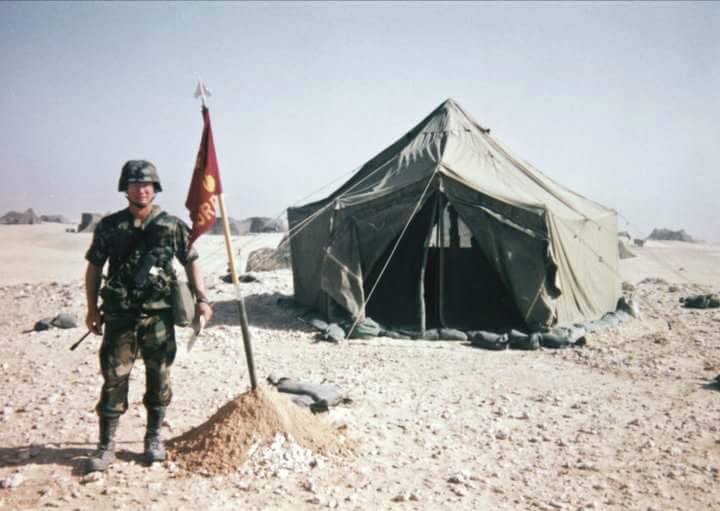
Perhaps most important of all, we had the flag. When I learned upon taking command that none had been brought from Germany, one of my earliest acts was to write my mother’s congressman, Rep. Joe Moakley. I explained to him what it would mean to the soldiers and requested that he do what he could to help us. In an amazingly short time, a box arrived which I opened like a little boy at Christmas. It was all that I had asked for and more. “This flag,” read the beautiful certificate, “has been flown above the United States Capitol in the name of the 45th Ordnance Company.” A moving and encouraging letter was enclosed.
SGT Heath, my outstanding carpenter, immediately raised a flag pole of eight camouflage support sections, anchored by carefully piled sandbags. Somehow, (and I never asked “how” when he was on the job), SGT Heath rigged a terrific pulley and a tie-off, for raising and lowering the flag, which I did every morning and evening for the next four months. The certificates and letter went under acetate on a board and were mounted on the pole. Hours after its arrival, Old Glory waved proudly above the company area, forever to be the most beautiful sight I have ever seen. Set upon the highest ground in the area, it was visible for over a mile and quickly became the reference point for directions to any unit in the vicinity. Nearly every soldier in the company posed at its base for a picture. It flew for the entire war, and the two proudest re-enlistments of my command were accomplished as it waved overhead.
Five months after fearfully and tearfully kissing our loved ones goodbye, we stormed from the buses to kiss them hello. We were veterans of battle that will never appear in any history of the conflict, victors over the boredom and uncertainty that had proven to be our most dangerous enemies. That which had not killed us had made us stronger.
 The Official 45th Ordnance Company - Operation Desert Shield / Storm