More than 35 years after American troops deployed to the Persian Gulf, veterans of Operations Desert Shield and Desert Storm are about to have a permanent national memorial in Washington, D.C.
The Desert Shield and Desert Storm Memorial is now under construction near the Lincoln Memorial on the National Mall. After years of legislation, site battles, design reviews, fundraising and construction, the memorial is scheduled to be dedicated and opened to the public on Saturday, October 24, 2026. The public dedication ceremony is scheduled for 11:00 a.m. EDT. (militarytimes.com)
For the generation that served in the Persian Gulf in 1990 and 1991, the memorial represents something that has been missing from Washington for decades: a permanent place devoted specifically to their service, their victory and their sacrifices.
The war the memorial will remember
The story began on August 2, 1990, when Iraqi forces under Saddam Hussein invaded Kuwait. Within a day, Iraqi forces controlled the small Persian Gulf nation.
President George H. W. Bush responded on August 7 by beginning Operation Desert Shield, sending American forces to Saudi Arabia to defend the kingdom and prevent Iraq from expanding the war. Over the following months, hundreds of thousands of American service members deployed to the region as the United States assembled an international coalition and pursued diplomatic efforts to force Iraq from Kuwait. (Squarespace)
When Iraq failed to meet the January 15, 1991 deadline to withdraw, the coalition began Operation Desert Storm on January 17. The campaign opened with a massive air offensive. After weeks of bombing, coalition ground forces attacked into Iraq and Kuwait in February. The ground campaign lasted roughly 100 hours before Kuwait was liberated and President Bush announced a cease fire on February 28. (Squarespace)
The military victory was extraordinarily fast, and that success may have contributed to the war fading from public attention more quickly than longer American conflicts.
Scott C. Stump, a Marine Corps Reserve veteran who served during Desert Shield and Desert Storm, became convinced that the war and those who fought it were not receiving the national recognition they deserved. He began pursuing the idea of a national memorial around 2010, as the twentieth anniversary of the conflict approached. The organization that became the National Desert Storm Memorial Association has worked toward that goal ever since. (NDSWM)
Stump told Military Times in August 2026 that Desert Shield and Desert Storm had, in some respects, become victims of their own success. He recalled attending veterans events where other conflicts were recognized while the Gulf War was sometimes passed over. For him, that was particularly troubling when thinking about the families of those who never returned. (Military Times)
Getting a memorial authorized
Turning that idea into a national memorial took years.
Congress authorized establishment of the memorial in legislation signed by President Barack Obama in December 2014. The law authorized the National Desert Storm Memorial Association to establish a commemorative work honoring members of the Armed Forces who served during Operations Desert Shield and Desert Storm. It also prohibited the use of federal funds to build the memorial, meaning the project would depend on private fundraising. (Park Planning)
Another major step came in March 2017, when legislation signed by President Donald Trump allowed the memorial to be located in Area I, the section of Washington reserved for commemorative works considered to have lasting national significance. (Park Planning)
The site selection process itself became a major part of the struggle. More than 20 possible locations were initially examined before the process narrowed the choices. The location ultimately selected was one of the most prominent available sites near the National Mall. (Park Planning)
Where the memorial is located
The memorial is being built in West Potomac Park at the southwest corner of Constitution Avenue NW and 23rd Street NW in Washington, D.C.
It sits just northwest of the Lincoln Memorial and near the Vietnam Veterans Memorial. The United States Institute of Peace is immediately to the north. The National Park Service administers the site as part of National Mall and Memorial Parks. (Commission of Fine Arts)
The location was chosen for more than visibility.
Constitution Avenue has a direct connection to the Gulf War. After the victory in 1991, American troops, vehicles and military equipment moved down Constitution Avenue during the National Victory Celebration in Washington. Memorial designers have described the location as a symbolic meeting of diplomacy and ceremony. Diplomacy was essential to assembling the international coalition that confronted Saddam Hussein, while Constitution Avenue became the setting for the national celebration that followed Kuwait’s liberation. (Park Planning)
Its proximity to the Vietnam Veterans Memorial carries another meaning. Planning documents for the Desert Storm memorial note the change in the relationship between the American public and its military following Vietnam. The reception given to returning Gulf War troops in 1991 was dramatically different from what many Vietnam veterans had experienced two decades earlier.
Placing the two memorials near one another creates a physical connection between those generations.
A memorial designed around the war itself
The memorial will not simply be a traditional monument surrounded by a plaza.
Its landscape and architecture are intended to make visitors feel as though they are moving through the story and environment of Desert Shield and Desert Storm.
The roughly one acre memorial uses curved walls, earth forms and landscaping to create an enclosed experience. The National Park Service approved a design built around two curving sculptural walls, a central commemorative feature, landscaped berms, seating, lighting and accessible entrances. (Park Planning)
One of the most important features is the Storm Wall, which uses sculpted reliefs to tell the story of the military campaign. The imagery moves through different phases of the war, including the air campaign and the ground offensive.
The overall circular and sweeping movement of the memorial was influenced by the famous coalition maneuver commonly called the Left Hook, in which ground forces moved far west into Iraq before turning east against Iraqi forces. Designers wanted the visitor’s movement through the memorial to suggest the speed and motion of the campaign. (Military Times)
Even the stone was selected to reinforce that idea. Stone quarried in Brazil has a color and texture intended to suggest the barchan dunes found in Kuwait. According to the design team, the stone changes appearance depending on sunlight and moisture, shifting from lighter desert tones to darker shades when wet. (Military Times)
At the center will be a large Unity Shield honoring the international coalition. It incorporates Kuwait’s national flower and references the nations that joined together to liberate Kuwait. Water will move across and around the central feature, creating an oasis effect within the desert inspired landscape. (Military Times)
The Commission of Fine Arts completed its review of the final design in June 2025. Its approval covered the site, landscaping, Inscription Wall, Unity Shield and sections of the Storm Wall. (Commission of Fine Arts)
How the memorial is being paid for
The memorial was required by law to be constructed without federal appropriations.
That meant its supporters had to raise the construction money themselves.
The project is now reported to cost approximately $42 million. Kuwait, the nation whose liberation was the central objective of Desert Storm, provided more than half of the project’s funding. Other money has come from individuals, veterans organizations, businesses and other supporters. (Bizjournals)
Once completed, the memorial will become part of the National Park Service system.
Construction is now in its final stretch
The ceremonial groundbreaking took place on July 14, 2022, but much of the early work occurred away from the Washington site as stone, sculpture and other specialized elements were fabricated.
The National Park Service issued the project’s construction permit on March 6, 2025, clearing the way for full construction at the National Mall site. (NDSWM)
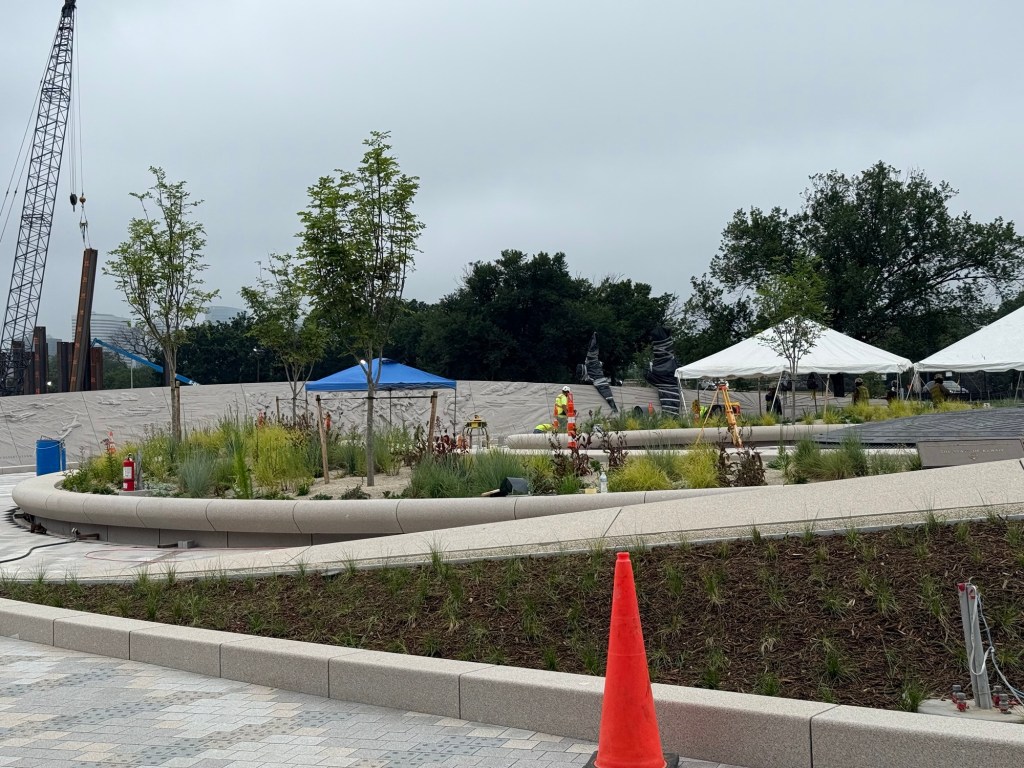
By 2026, the memorial had become unmistakably visible above the construction fencing. Foundations, curved walls and major landscape elements were taking shape while specialized artwork and architectural components continued to be installed.
Recent reporting provides the clearest indication yet that the project is nearing completion. Military Times toured the construction site during the summer of 2026 and reported on August 3 that the memorial remained under active construction but was scheduled to open to the public on October 24. The tour showed the major architectural form of the memorial already in place while work continued on its artwork, landscaping, water features and finishing details. (Military Times)
That date is no longer simply a general goal for sometime in 2026. The National Desert Storm Memorial Association formally announced the dedication date on January 11, 2026.
October 24, 2026
The Desert Shield and Desert Storm Memorial dedication ceremony will take place Saturday, October 24, 2026, at 11:00 a.m. EDT.
The ceremony is open to the public and will be held at the memorial site at Constitution Avenue and 23rd Street NW. The memorial is also scheduled to open to the public that day. (Squarespace)
It will mark the end of a campaign that began around 2010 and lasted longer than the military operation the memorial commemorates.
For Desert Shield and Desert Storm veterans, that may be the most important part of the story.
The war was brief. Their service was not insignificant.
Beginning October 24, their generation will finally have a permanent place in the nation’s capital where families, veterans and future generations can walk through the story of the buildup in the Saudi desert, the coalition effort, the air war, the ground offensive, the liberation of Kuwait and the Americans who served there.
Thirty five years after the victory, Desert Shield and Desert Storm will have a permanent place on the National Mall.
Sources
Desert Shield and Desert Storm Memorial official website
Memorial construction timeline and dedication information
National Desert Storm Memorial Association important dates
National Park Service memorial planning page
National Park Service environmental decision and memorial design
Commission of Fine Arts final design approval
Military Times, August 3, 2026 construction update and opening report

